Summary: You've heard the name—now understand the threat. We break down the Medusa RaaS model, their core TTPs, and how IT teams can stop their attempts.
You likely already track the biggest names in ransomware. But the security challenges we face change fast, and groups that may have started quietly can quickly turn into major operational issues. Meet Medusa ransomware—a key player in the Ransomware-as-a-Service (RaaS) game that has consistently demonstrated a high degree of maturity, hitting critical sectors from healthcare to manufacturing.
Medusa’s tactics have evolved into aggressive, high-pressure double and even triple-extortion schemes. They're using sophisticated techniques, exploiting known vulnerabilities for initial access, and expertly blending into legitimate network traffic—making detection a serious challenge for even the most robust IT security teams.
In this analysis, we will break down the Medusa group's full lifecycle: who they are, their preferred tactics, techniques, and procedures (TTPs), and the specific steps you can take to stop an attack.
Key takeaways
What it is: The Medusa ransomware group runs a sophisticated
RaaS model focused on high-pressure double extortion.
The threat: Medusa encrypts data and steals sensitive files, threatening public release on their "Medusa blog" leak site to maximize leverage.
How they get in: Initial access is typically gained through common entry points: Medusa ransomware gang phishing campaigns, weak Remote Desktop Protocol (RDP) credentials, or exploitation of unpatched, public-facing systems.
Why it's dangerous: The attacks cause huge operational downtime, financial loss, reputation damage, and severe compliance risks (like HIPAA or GDPR fines).
Early detection: Look for key indicators of compromise (IOCs), such as strange admin scripts running, antivirus software being disabled, and large, unusual outbound data transfers.
Defense fundamentals: Reduce exposure by implementing strong, offline immutable backups, universal MFA, consistent patching, and network segmentation.
Stopping the crisis: A well-prepared and tested
incident response plan is absolutely crucial to isolate systems quickly and limit damage.
So, what is Medusa ransomware and who is behind it?
The name Medusa ransomware is probably one you’ve seen flashing across recent threat intelligence reports. It is a highly organized criminal operation built on the Ransomware-as-a-Service (RaaS) business model—and it’s quickly become a top problem for IT and security teams worldwide.
So, what exactly does it do? At its core, Medusa aims to bring a company to a screeching halt. It infiltrates the network, hunts down critical files, encrypts them (often slapping on the “.medusa” file extension), and secretly exfiltrates data to a remote server. Then comes the demand for payment. This group, often referred to simply as the “Medusa threat actors” or the “Medusa ransomware group,” targets virtually every valuable sector, from corporate networks to healthcare, education, and even critical infrastructure.
The level of threat is high enough that the FBI warning specifically called out the use of Medusa ransomware phishing campaigns targeting everyday users with services like Gmail and Outlook—a common starting point for these attacks.
Key tactics of Medusa
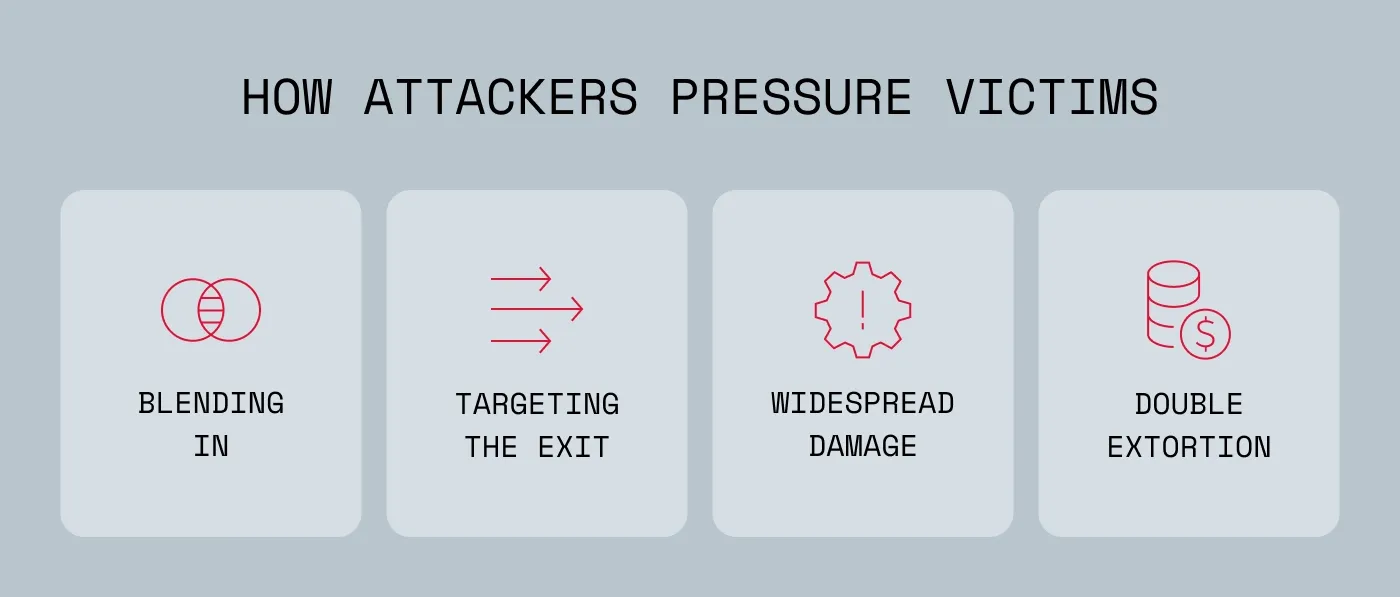
What really separates Medusa from some other ransomware groups is the sophistication of its attack path before the encryption even starts. They operate like a professional intrusion service, focused on speed and evasion:
Blending in. These attackers often use tools that are already installed on your network, like PowerShell or RDP. This tactic, known as "Living Off the Land," helps them move around and escalate privileges without triggering standard anti-malware alerts.
Targeting the exit. Before they encrypt anything, the Medusa threat actors actively kill off security systems, backup processes, and database services. They also delete shadow copies, ensuring that when the encryption hits, recovery is nearly impossible.
Widespread damage. They use automated tools to quickly deploy the malicious payload across the network. This means the infection spreads fast and wide, maximizing the disruption to operations.
Double extortion. First, your files are locked. Second, they threaten to publish the sensitive, stolen data publicly unless you meet their deadline. This two-pronged approach puts massive commercial and legal pressure on the victim, forcing a quick decision to protect both operations and reputation. To prove they are serious, the Medusa ransomware gang runs a public "leak site"—sometimes known as the "Medusa blog." They use this site to post proof-of-life data from companies that refuse to pay. If the victim continues to ignore the ransom, they release the full set of exfiltrated data.
How Medusa ransomware works
To defend against the Medusa ransomware threat, your team needs to understand the enemy’s playbook. A ransomware attack is never a single event. It’s a coordinated, multi-step process. By breaking down the attack into its three main phases, we can see exactly where to place our security checkpoints.
Phase #1 How attackers get in
The most important step for the Medusa ransomware group is gaining initial access. Often, they don’t even need an elaborate zero-day exploit—they just need a single point of weakness.
Phishing emails and infected attachments. This is the most common entry point. A user is tricked into clicking a link or opening a malicious file received via email. The Medusa ransomware phishing campaign is usually the simple launchpad that lets the initial malware loader drop into the system.
Weak credentials and RDP access. Poorly protected administrative tools, like Remote Desktop Protocol (RDP), are a major risk. Attackers often use brute-force tools to guess weak passwords, gaining direct, authorized access to an internal machine.
Exploiting software bugs. If your team hasn't patched critical software, attackers can use known software vulnerabilities in public-facing applications (like VPNs, web portals, or unpatched servers) to bypass security measures and get an initial foothold.
The common thread here is that users or IT systems can unintentionally let the Medusa ransomware in, whether through a momentary lapse in judgment or delayed patching schedules.
Phase #2 How the ransomware spreads and gains control
Once the malware is inside, its primary goal is to take over the network, not just the initial device. This is the quiet, crucial phase of the attack.
Lateral movement. The ransomware payload quickly attempts to spread to other devices on the same network. It searches for shared drives, linked resources, and other systems it can compromise.
Disabling defenses. A key early action is disabling the security net. The malware actively terminates and disables antivirus tools, endpoint detection and response (EDR), and backup services. If your security tools aren't running, they can’t alert you.
Gaining admin access. To move freely and hit the highest-value targets (like domain controllers), the attackers need high-level permissions. They escalate privileges, often by stealing credentials and impersonating admins to gain more access across the organization.
Phase #3 How it encrypts and steals data
This is the final, high-impact phase where the damage is solidified, activating the double extortion tactic.
Stealing files first. Before the encryption locks anything down, the attackers execute the first half of the extortion plan. Sensitive files, personally identifiable information (PII), and company secrets are uploaded to attacker-controlled servers in a discreet process known as data exfiltration.
Strong encryption methods. The Medusa payload is then deployed. It uses robust, industry-standard strong encryption methods (often variations of AES and RSA) to mathematically scramble all targeted files. This process renders the files useless and makes decryption impossible without the private key.
The demand. The system is left crippled, and a ransom note appears. The Medusa ransomware group demands payment, typically a large sum in cryptocurrency, in exchange for the decryption key and, crucially, a promise not to release the stolen data publicly on their "Medusa blog."
Related articles

Aurelija EinorytėJan 15, 20258 min read

Joanna KrysińskaNov 12, 202512 min read
How Medusa attacks hurt your business
When a Medusa ransomware attack hits, the encryption and the ransom demand are only the beginning. The true cost of being one of the Medusa ransomware victims is often measured in months of operational chaos, irreparable damage to trust, and steep regulatory fines.
Financial damage beyond the ransom
While the ransomware attack is fundamentally about money, the ransom payment itself can be the smallest part of the total financial hit.
Downtime and operational loss. Once files are locked and systems are down, operations stop. This leads to lost sales, missed production quotas, and crippling business interruption costs. The recovery effort alone—cleaning and rebuilding infected systems—takes up valuable IT time and resources, pulling focus from core projects for weeks or even months.
Ransom and recovery fees. Ransom demands from the Medusa ransomware group often range from hundreds of thousands to millions of dollars. Even if the ransom is paid (which experts do not recommend), there is no guarantee you will receive a functional decryption key. Plus, you’re still left paying for forensic experts, legal teams, and crisis communicators.
Other financial losses. Remember the stolen data? Even if you avoid the publication threat, you must still budget for customer notification costs and credit monitoring services if PII was compromised.
Reputation and trust
In a double extortion scenario, reputation becomes a key target. The Medusa group knows that public shame is a powerful motivator to pay.
Reputational ruin. By stealing and threatening to publish data on their Medusa blog, the threat actors turn your private crisis into a public spectacle. This immediately damages your brand, makes potential customers wary, and can sour relationships with partners and suppliers.
Eroding customer trust. If patient records, financial information, or client data are leaked, customer trust is shattered. Rebuilding that trust requires significant time, expense, and transparent communication, none of which are guaranteed to work.
Legal and compliance fallout
Data theft involving sensitive information can trigger severe legal and regulatory issues that last long after your systems are back online.
Regulatory penalties. If the stolen data includes patient health information (PHI) or the personal data of EU citizens, you are looking at serious compliance issues. Failure to protect this data can result in huge fines under regulations like HIPAA or GDPR, multiplying the financial disaster.
Lawsuits and litigation. A public data leak almost inevitably leads to class-action lawsuits filed by affected employees, partners, or customers seeking damages for the exposure of their personal or financial information.
Real-world example
The scale of this threat is clearest when looking at specific Medusa ransomware victims. In 2023, for instance, Toyota Financial Services faced a massive $8 million ransom demand after Medusa accessed their systems in Central Europe. The data stolen was highly sensitive—including cleartext user IDs, passwords, agreements, and financial reports—demonstrating how quickly a breach can escalate into an eight-figure extortion attempt.
How do you detect and respond to Medusa?
The very best defense, frankly, is catching the attackers before they can encrypt anything. Because the Medusa ransomware group spends days or even weeks lurking quietly inside your network, being able to recognize the early warning signs—the indicators of compromise—is absolutely vital. A fast, clean response, as you know, is the difference between a minor incident and total operational meltdown.
Warning signs to keep an eye on
Since Medusa ransomware is designed to sneak past your standard security controls, your IT and security teams need to become detectives, looking for clues that show an attacker is present and active.
Suspicious system activity. Look for things that just seem off. Is a basic employee's machine suddenly running admin scripts? Are tools like PowerShell or RDP being used on systems they usually wouldn't touch? The threat actors are deliberately trying to "Live Off the Land" (meaning they use your own tools) to keep from getting noticed.
Defenses going dark. The step right before a massive ransomware attack is always the disabling of security processes. If your antivirus, EDR, or backup services abruptly stop running, you should assume an immediate compromise and start investigating.
Suspicious network traffic. Remember, the Medusa threat actors steal your data before they lock your files. You need to look for abnormally large, encrypted outbound data transfers that scream "data exfiltration." This requires active filtering of network traffic and behavioral analysis.
The final proof of a Medusa ransomware attack. The most definite, unwelcome sign is, of course, the appearance of a ransom note (like the famous “!! READ_ME_MEDUSA!!!.txt” file) or files suddenly appearing with strange extensions.
What to do after an attack hits
If you confirm a Medusa ransomware attack is underway, you don't have time to panic. You need to execute a clinical, coordinated response focused on two things: containment and guaranteed recovery.
1. Containment first
You have to stop the spread immediately. Isolate infected systems by physically unplugging network cables, disconnecting Wi-Fi, or blocking traffic at the firewall/switch level. A key piece of advice here: don't just power them down, as you might lose crucial forensic data in the volatile memory.
2. Get the right people involved
You are definitely not fighting this battle alone. Contact law enforcement—your local FBI field office or a similar agency—to report the cybersecurity alert. At the same time, get your incident response core team together immediately: legal, communications, and IT leads.
3. Secure and restore
You should never pay the ransom. Your leverage against the ransomware group is a reliable backup. Focus on:
Restoring from clean backups. The goal is to restore data from clean, verified, and offline backups into a brand-new, sterile network environment. If those backups are clean, you win.
Change everything. You need to assume every administrative account has been compromised. Change passwords, switch to hardware-based MFA everywhere, and thoroughly audit all user and admin access for unauthorized modifications.
4. Learn from it
Once the fire is out, you have to manage the fallout. Stress the importance of clear communication and transparency with affected users or partners—that's how you start rebuilding the trust that was damaged. Finally, use the lessons learned from this attack to permanently strengthen your defenses by patching every single vulnerability the ransomware group exploited.
Protecting your business from ransomware attacks
When you are facing serious threats like the Medusa ransomware group, your goal moves past simply recovering from an attack. Instead, you need to build an environment so strong and so difficult to penetrate that bad actors simply move on to an easier target. To get there, we need to focus on implementing solid security fundamentals and using modern threat intelligence for continuous, proactive vigilance.
Offline and immutable backups. This is your absolute fail-safe. If your backups are offline (air-gapped) and immutable (meaning they can't be modified or deleted), you instantly neutralize the encryption threat. If you can restore everything, the attackers lose their leverage.
Patch management and MFA. Eliminate easy entry points. You need a rigorous process for applying patches, especially to public-facing systems, and universally enforce MFA for all accounts, shutting down password exploitation.
Least privilege and segmentation. Adopt the principle of least privilege (users only get the access they need for their job). Then, use network segmentation to isolate critical systems. This severely limits the attacker’s ability to move laterally across the enterprise.
Zero Trust architecture. Moving toward a Zero Trust model means never trusting anything, inside or outside the network. This inherently resists the lateral movement that Medusa relies on.
Security audits and training. Bring in third parties for regular security audits to find weaknesses before the ransomware groups do. Also, regularly train employees on security awareness so they can spot and report potential phishing campaigns.
Continuous visibility with NordStellar
Medusa can quietly sneak into your systems, but you can spy on it too. You can’t defend against a threat you don’t see coming, and that’s why continuous monitoring is key. A platform like NordStellar gives your security team the continuous visibility needed to stay ahead of the Medusa ransomware threat, helping you detect it if attackers ever pick your organization as their next target.
It actively monitors external surfaces where the attackers operate:
Dark web monitoring. NordStellar alerts you to threats like Medusa ransomware activity, specific keywords, and any mentions of your brand, partners, or employee data appearing on the dark web, Telegram channels, or their notorious Medusa blog.
Attack surface management. By continuously mapping your external environment, NordStellar helps you spot the forgotten assets and unpatched services that the attackers would target for initial access.
Data breach monitoring. If any data associated with your organization is leaked by the Medusa threat actors onto the dark web, NordStellar flags it instantly, allowing you to react and manage the compliance fallout much faster.
Try NordStellar for free and learn how it can monitor the dark web for signs of compromise and protect your attack surface today.

Aistė Medinė
Editor and Copywriter
An editor and writer who’s into way too many hobbies – cooking elaborate meals, watching old movies, and occasionally splattering paint on a canvas. Aistė's drawn to the creative side of cybercrime, especially the weirdly clever tricks scammers use to fool people. If it involves storytelling, mischief, or a bit of mystery, she’s probably interested.